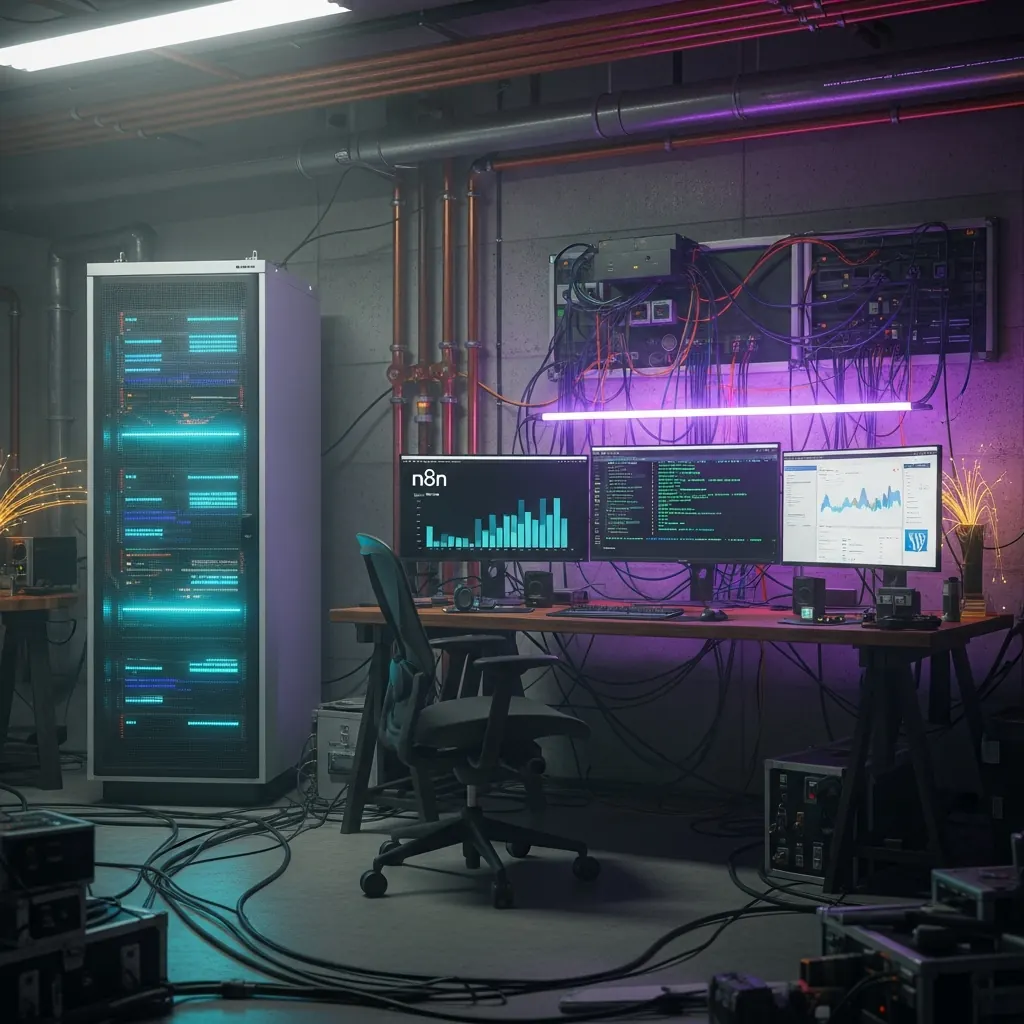
The Hum of Sovereignty
The hum. It’s a low, persistent thrum, a digital heartbeat emanating from the corner of my office. For most, it’s just the sound of a server. For me, it’s the symphony of my own digital workforce, a virtual agency humming to life while the world sleeps. Forget the cloud-bound behemoths and their opaque APIs. We’re talking about Sovereign AI, about owning your intelligence, and building a digital entity that works for you, not the other way around.
This isn’t just a hobby; it’s a declaration. A declaration against data silos, against escalating API costs, and against the passive consumption of AI as a mere tool. This is about building an autonomous workforce, a testament to the power of local, self-hosted intelligence. And today, I’m pulling back the curtain on how I’m doing it, piece by digital piece.
The Why: Data Privacy, Zero API Costs, and the Thrill of Ownership
Let’s cut to the chase. Why go through the trouble of setting up a local AI server when the cloud offers seemingly endless power? Three core tenets drive this endeavor:
- Data Sovereignty: My data, my rules. In a world where personal and business data is a commodity, keeping it local is paramount. My AI agents operate within my network, processing information without it ever touching a third-party server. This isn’t just about privacy; it’s about control.
- Zero API Costs (Post-Hardware): The allure of cloud AI services is undeniable, but the meter is always running. For a continuously operating agency, these costs can quickly become astronomical. By investing in local hardware and open-source models, I’m building an infrastructure with a predictable, one-time hardware cost and zero per-query fees. This unlocks true scalability without financial handcuffs.
- The Satisfaction of Owning Your Intelligence: There’s a profound sense of accomplishment in building something from the ground up. It’s the digital equivalent of forging your own tools. When an AI agent performs a task, it’s not a black box responding to a prompt; it’s a component of my system, a manifestation of my architecture. This ownership fosters a deeper understanding and a more creative approach to AI development.
The Stack: The Brain, The Hands, and The Face
Every agency needs its core components. Mine is a carefully curated stack, each piece playing a vital role in bringing my virtual workforce to life.
The Brain: Ollama – The Local Intelligence Core
At the heart of my Sovereign AI lies Ollama. This is where the magic of large language models (LLMs) happens, locally. Ollama simplifies the process of downloading, running, and interacting with powerful open-source models like Llama 3 and Mistral.
- Model Selection: The choice of model is crucial, especially on constrained hardware. I’m currently experimenting with
llama3:8b, a fantastic balance of capability and resource requirements. The8b(8 billion parameters) is a sweet spot for my current setup. - Hardware Constraints: This is where the “local frontier” truly bites. My AMD Ryzen 7 3700U with its 4 Cores / 8 Threads and 2.3 GHz base clock is a capable CPU, but the integrated AMD Radeon RX Vega 10 Graphics is the bottleneck. Integrated GPUs share system RAM, and this is where VRAM becomes a critical constraint. Loading larger models requires significant VRAM, and I’m constantly optimizing model quantization and selection to fit within my available memory. It’s a constant dance between performance and resource management.
The Hands: n8n – The Orchestrator and Nervous System
If Ollama is the brain, n8n is the nervous system. This open-source workflow automation tool is the unsung hero of my virtual agency. It’s where the logic resides, where agent interactions are defined, and where the entire operational flow is orchestrated.
- Agent Loops: n8n excels at creating complex workflows. I can design “agent loops” where one agent’s output becomes another agent’s input, creating a chain of reasoning and action.
- API Integration: n8n seamlessly connects to Ollama’s API for model inference, and crucially, to WordPress’s REST API for content publishing. This allows my AI agents to not only think but also to act in the digital world.
- Foreman: I’m running n8n via its “Foreman” mode, which is designed for long-running, automated workflows. This ensures my agency can operate continuously without manual intervention.
The Face: WordPress – The Agency’s Storefront and Output Channel
Every agency needs a way to present its work to the world. For me, that’s WordPress. It serves as:
- The Storefront: My agency’s website, showcasing its capabilities and services.
- The Content Output: The final destination for AI-generated articles, blog posts, and other content. n8n pushes the processed output directly into WordPress, ready for review or immediate publication.
- The Gateway: My Nginx reverse proxy is the gatekeeper, managing incoming traffic. It routes requests to the Agency Dashboard (Port 8000), n8n/Foreman (Port 5678), and the Ollama API (Port 11434). This ensures secure and organized access to my local services. My domain,
daryl-base.duckdns.org, is the public face of this local operation.
Orchestration Magic: The Beauty of n8n Loops
The real power of this setup lies in the intricate dance orchestrated by n8n. Let’s break down a typical workflow:
- The Prompt: A trigger event (e.g., a new idea from a human prompt, a scheduled task) initiates a workflow in n8n.
- Ollama’s Thought Process: n8n sends the prompt, along with specific instructions and context, to Ollama via its API. This is where the LLM “thinks.”
- Example: “Generate a blog post outline about the benefits of local AI for small businesses.”
- Agent Specialization (Conceptual): Within n8n, I can design workflows that mimic specialized agents. For instance:
- The Researcher Agent: Takes a broad topic, queries Ollama for key points and supporting data.
- The Writer Agent: Takes the research output, structures it into a coherent article, and refines the language.
- The Editor Agent: Reviews the generated content for tone, grammar, and factual accuracy (though this is still heavily reliant on the LLM’s capabilities).
- Ollama’s Response: Ollama processes the request and returns the generated text to n8n.
- WordPress Integration: n8n then takes this generated text and uses the WordPress REST API to create a new post, assign categories, set tags, and even schedule publication.
This loop is the engine of my virtual agency. It’s dynamic, adaptable, and entirely under my control. The beauty of n8n is its visual interface, allowing me to map out these complex interactions without writing extensive code for each agent.
Challenges of the Local Frontier: VRAM Limits, Latency, and Model Selection
Building a Sovereign AI agency on local hardware isn’t without its hurdles. The “local frontier” presents unique challenges that require constant innovation and optimization:
- VRAM Constraints: As mentioned, the integrated GPU’s shared VRAM is the primary bottleneck. Loading larger, more capable models like
llama3:70bis currently out of reach. This forces a focus on:- Quantization: Using quantized versions of models (e.g., 4-bit or 8-bit) significantly reduces their VRAM footprint.
- Model Selection: Prioritizing smaller, yet highly capable models that fit within available memory.
- Offloading: Exploring techniques to offload parts of the model computation to the CPU, though this comes with a performance penalty.
- Latency: While cloud APIs can offer high throughput, local inference can introduce latency, especially for complex queries or when the CPU is heavily utilized. This impacts the responsiveness of the agency.
- Model Selection & Fine-tuning: The open-source LLM landscape is evolving rapidly. Choosing the right model for specific tasks and potentially fine-tuning them on custom datasets is an ongoing process. This requires a deep understanding of model architectures and training methodologies.
- Hardware Upgrades: While the goal is zero ongoing API costs, the initial hardware investment is significant. Future upgrades to accommodate larger models will be a consideration.
These challenges are not deterrents; they are the very essence of the “build-in-public” ethos. They represent the cutting edge of personal AI development, where ingenuity and resourcefulness are key.
The Vision: From AI as a Tool to AI as an Autonomous Workforce
We are witnessing a paradigm shift. For years, AI has been a tool – a sophisticated hammer in our digital toolbox. We prompt it, it responds. We use it, then we put it away.
My vision for this Sovereign AI Virtual Agency is to move beyond this passive relationship. I’m building an autonomous workforce. These aren’t just tools; they are digital employees, each with a defined role and the ability to collaborate.
Imagine:
- An AI content strategist that identifies trending topics.
- An AI writer that drafts articles based on those trends.
- An AI social media manager that schedules and posts content.
- An AI customer service agent that handles initial inquiries.
All of this, running on my own hardware, powered by open-source models, and orchestrated by my own logic. This is the future of the one-person “Mega Agency,” where a single individual can leverage the power of a distributed, autonomous workforce without the overhead of traditional employment or the dependency on external services.
The hum of my server is more than just electricity and spinning fans. It’s the sound of innovation, of independence, and of a future where we don’t just use AI, we build it, we own it, and we let it work for us, tirelessly, in the digital ether. The journey is ongoing, the challenges are real, but the potential is limitless. Join me on this frontier.
Leave a Reply